August 22, 2026
Blog Details
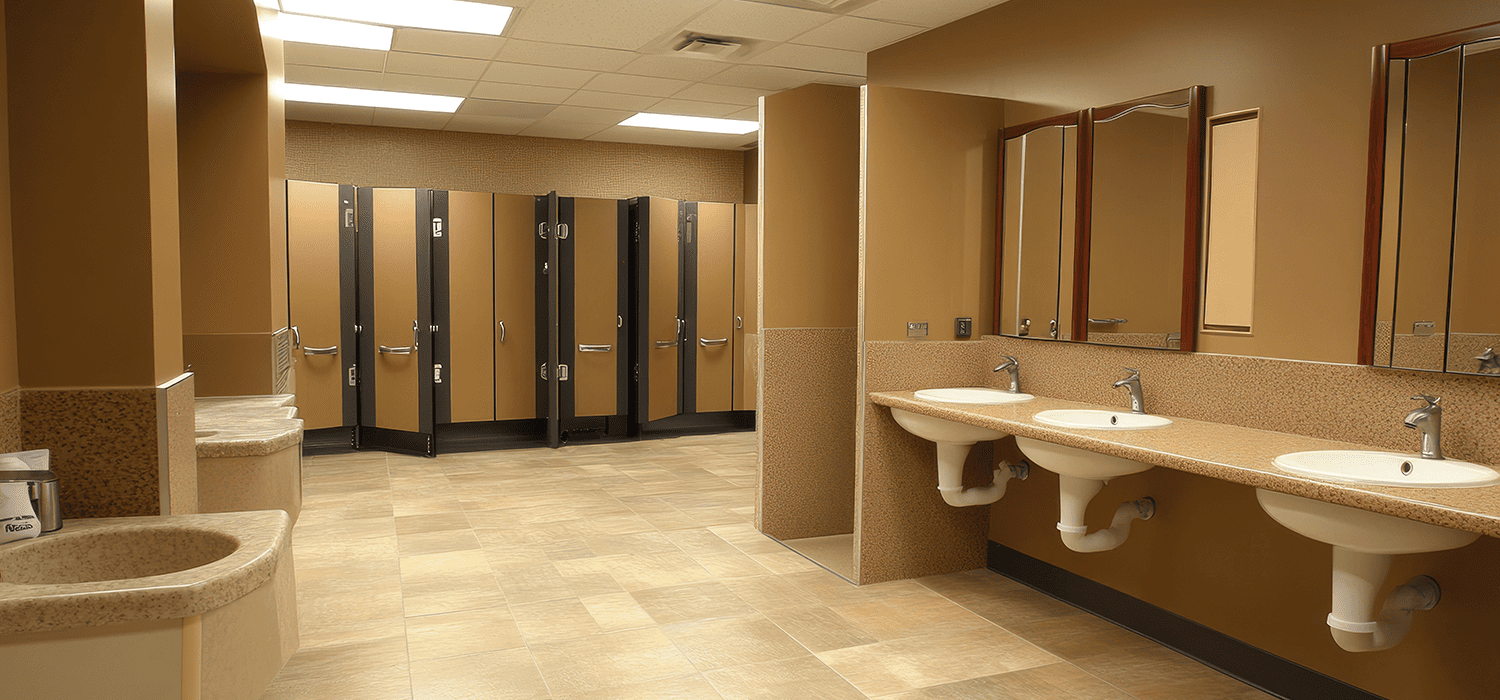
In the modern architectural landscape, commercial restrooms have evolved far beyond purely functional service zones. Today, they are viewed as vital extension points of a brand's identity, sustainability commitment, and user-centric philosophy. Whether in high-end corporate headquarters, international airports, luxury retail hubs, healthcare facilities, or educational institutions, the design of commercial restrooms plays a powerful role in shaping public perception.
As we look at the restroom cubicle design trends dominating commercial spaces in 2026, the focus has clearly shifted toward a harmonious blend of sleek aesthetics, full-privacy architectures, contactless hygiene, and high-performance structural materials. Architects and interior designers no longer compromise on durability for the sake of style; instead, they rely on advanced surface solutions like compact laminates to deliver robust, long-lasting, and visual excellence across global developments.
Here is a comprehensive breakdown of the defining commercial restroom cubicle design trends for 2026 and how cutting-edge surface materials are making them possible.
Full-Height Floor-to-Ceiling Privacy Architecture
The era of standard partitions featuring large top and bottom gaps is rapidly drawing to a close. Modern commercial restroom cubicle design prioritizes absolute privacy and personal comfort.
The Rise of the Fully Enclosed Cubicle
Driven by user demand for enhanced personal space, privacy, and acoustic isolation, 2026 design standards heavily favor floor-to-ceiling cubicle systems. These zero-sightline designs feature overlapping door edges or interlocking rebate systems that eliminate vertical visual gaps entirely.
- Acoustic Comfort: Full-height partitions, paired with solid-core materials, significantly dampen sound transmission, providing users with a comfortable, private environment.
- Universal Design: Gender-neutral and all-gender commercial facilities rely on floor-to-ceiling cubicles to create safe, comfortable, and dignified spaces for all occupants.
- Minimalist Aesthetics: Extending partitions from floor to ceiling creates clean, unbroken vertical lines that elevate the architectural profile of the entire washroom.
Advanced Material Science: The Domination of Solid Compact Laminates
Designing commercial restrooms requires materials capable of standing up to relentless daily traffic, frequent cleaning with heavy chemical agents, high humidity, and potential impacts. In 2026, solid compact laminate—often referred to as phenolic core board—has firmly established itself as the gold standard for restroom cubicle design.
Why Compact Laminate Leads the Market
Unlike traditional particleboard or medium-density fiberboard (MDF) covered with thin laminates, solid compact laminates are self-supporting, extremely dense, and intrinsically water-resistant.
Commercial specifiers choose compact laminate for several key reasons:
- Total Moisture & Water Resistance: Non-porous construction ensures the panels will never swell, delaminate, rot, or warp when exposed to high humidity or wet cleaning procedures.
- High Impact Resistance: Possessing a density exceeding 1350 kg/m³, compact laminate absorbs heavy physical impacts in high-traffic environments like stadiums, transit hubs, and schools without denting or cracking.
- Vandal Resistance: Surfaces resist graffiti, scratches, and gouges. Solvent cleaning agents can be used to remove ink or paint without degrading the panel surface.
Hygiene-First Engineering & Antibacterial Surfaces
Post-pandemic commercial design continues to prioritize touchless technology and self-sanitizing surfaces. Modern washroom partitions are now active components of a facility's overall hygiene strategy.
WhAntibacterial Protection
Leading material manufacturers have integrated specialized anti-microbial and anti-bacterial technology directly into the resin matrices of compact laminates. Products like the VIR Vault variant actively inhibit bacterial reproduction and cross-contamination on contact surfaces.
- Integrated Protection: Because antibacterial additives are distributed throughout the surface layer during manufacturing, the protective effect does not wear off or wash away over time.
- Target Applications: Essential for healthcare facilities, laboratories, fitness centers, food service venues, and high-volume public restrooms.
- Seamless Maintenance: Non-porous surface structures prevent dirt, grime, and microbes from taking root, making daily sanitization fast, efficient, and thorough.
Minimalist Hardware & Floating Suspended Designs
The visual narrative of modern commercial restrooms is clean, uncluttered, and sophisticated. Frame hardware and visible fixtures are being streamlined or hidden entirely.
Key Hardware Trends in 2026
- Suspended / Floating Systems: Partitions engineered with concealed overhead bracing and minimalist floor clearances give the visual illusion of floating in air while leaving floor surfaces completely clear for effortless mopping and robotic cleaning systems.
- Matte Black & PVD Finishes: Bright chrome is largely being replaced by modern physical vapor deposition (PVD) coated hardware in matte black, brushed brass, champagne bronze, and satin nickel.
- Concealed Hinges & Soft-Close Mechanisms: Gravity-fall hinges and concealed hydraulic soft-close systems eliminate door slamming, protecting both the hardware and the partition structure while maintaining a quiet, refined atmosphere.
Nature-Inspired Biophilic Textures & Warm Earth Tones
While stark white and cool grey dominated commercial restrooms for decades, 2026 design palettes embrace warmth, texture, and biophilic connections. Commercial spaces are adopting richer materials to make restrooms feel more welcoming and hospitality-driven.
Popular Aesthetic Choices
- Architectural Woodgrains: High-definition compact laminate finishes replicate authentic timber grains—such as smoked oak, walnut, and muted ash—offering the warmth of real wood without its susceptibility to moisture damage.
- Tactile Super-Matte Surfaces: Anti-fingerprint, ultra-matte finishes reduce glare, resist smudges, and deliver a velvety, tactile experience under warm architectural lighting.
- Earth & Stone Tones: Terracotta, sage green, deep navy, warm taupe, and micro-cement textures ground the restroom environment, matching broader commercial interior design directions.
Global Reach, Compliance, and Life-Cycle Value
Commercial real estate developers and corporate tenants are increasingly bound by strict environmental, social, and governance (ESG) targets. Building materials are evaluated not just on initial purchase price, but on embodied carbon, long-term durability, and compliance with international standards.
World-Class Quality Across Global Markets
To meet the rigorous standards of global developers, high-performance compact laminates—such as VIR Vault—are engineered in strict accordance with international regulations, including the EN 438 European standard for compact laminate sheets. Their structural integrity, durability, and overall quality are rigorously verified through the standardized testing procedures outlined in EN 438-2. Additionally, to satisfy critical life-safety requirements, CGF panels are manufactured to conform with EN 13501-1 standards, ensuring certified, dependable fire performance across demanding architectural applications.
Trusted Export Footprint Across 63+ Countries
Meeting these rigorous global specs has enabled widespread international adoption. VIR Vault compact laminates are trusted by architects and builders across a vast global export network spanning major continents and trade corridors:
- North America & the Caribbean: United States, Canada, Mexico, Puerto Rico, Dominican Republic
- Central & South America: Guatemala, Honduras, El Salvador, Nicaragua, Venezuela, Peru, Brazil, Chile
- Europe & the Mediterranean: Portugal, Spain, Italy, Greece, Switzerland, Netherlands, Ireland, Slovakia, Romania, Bulgaria, Kosovo, Serbia, Latvia, Turkey, Russia
- Middle East: Saudi Arabia, UAE, Qatar, Kuwait, Bahrain, Oman, Jordan, Palestine, Israel, Iraq, Iran, Syria, Yemen
- Asia-Pacific: Australia, China, Hong Kong, Korea, Singapore, Malaysia, Thailand, Vietnam, Philippines, Indonesia, Brunei, Bangladesh, Nepal, Uzbekistan, Fiji
- Africa: Egypt, Sudan, Tunisia, Senegal, Cote d'Ivoire, Cameroon, Malawi
Choosing high-density compact laminate panels drastically lowers a facility's life-cycle cost. While lower-grade materials may require replacement or major repairs every 3 to 5 years due to moisture damage or wear, premium compact laminates engineered for export standards are built to last decades under rigorous use.
Frequently Asked Questions (FAQs)
What is a VIR Vault compact laminate?
VIR Vault compact laminate is a high-pressure, solid structural panel (also known as phenolic core board) engineered specifically for demanding interior applications such as commercial restroom cubicles, wall cladding, and lockers. It features a dense, solid core constructed from kraft papers impregnated with phenolic resin, faced on both sides with decorative papers impregnated with melamine resin. Highly durable and non-porous, VIR Vault is designed to provide exceptional resistance to water, impact, chemicals, and wear.
How is VIR Vault compact laminate manufactured?
VIR Vault compact laminate is manufactured using a high-pressure thermosetting process. Layers of cellulose-based kraft paper treated with phenol formaldehyde (PF) resin form the inner core. The decorative surface layers are treated with melamine formaldehyde (MF) resin for color stability, strength, and scratch resistance. These resin-soaked layers are subjected to intense heat (exceeding 120°C) and high pressure (over 5 MPa) simultaneously. This process cures the resins and fuses the layers into a single, homogeneous, high-density structural board with a density above 1350 kg/m³.
What are the main benefits of VIR Vault compact laminates?
The primary benefits of VIR Vault compact laminates include:
- 100% Water & Moisture Resistance: Will not rot, swell, or delaminate in humid or wet environments.
- Extreme Impact & Scratch Resistance: Dense core structure resists physical impacts, gouges, and heavy daily wear.
- Hygienic & Non-Porous: Easy to clean and maintain with standard detergents or organic solvents; available in an antibacterial variant for enhanced hygiene.
- Vandal & Chemical Resistant: Surfaces stand up to solvent-based cleaners used for graffiti removal without surface degradation.
- Fire Performance: Available in fire-retardant (FR) grades to meet commercial building code requirements worldwide.
Is VIR Vault manufactured according to EN 438 standards?
Yes. VIR Vault compact laminate is engineered and manufactured in strict compliance with EN 438 international standards. This ensures that the panels consistently meet rigorous benchmarks for density (exceeding 1350 kg/m³), dimensional stability, impact resistance, fire safety, chemical resistance, and structural durability required for export and global commercial construction projects.
Is VIR Vault suitable for demanding commercial applications?
Absolutely. Due to its high-density phenolic core, impact resilience, and imperviousness to moisture, VIR Vault is built specifically for heavy-duty, high-traffic commercial environments. It is an ideal surface material for restroom partitions, shower cubicles, wall cladding, laboratory surfaces, and locker systems in locations such as:
- Airports and public transit hubs
- Hospitals, clinics, and cleanroom environments
- Shopping malls and commercial office buildings
- Schools, universities, and sports complexes/gyms
What makes compact laminate different from regular laminate?
While both materials share similar surface chemistry, their structure, thickness, and performance differ significantly:
- Thickness & Self-Supporting Capability: Standard high-pressure laminate (HPL) is thin (typically 0.6 mm to 1.5 mm) and must be bonded or glued onto a substrate like plywood, MDF, or particleboard. Compact laminate is thick (typically 2 mm to 25 mm) and self-supporting, requiring no substrate.
- Core Construction: Compact laminate features a solid, multi-layered phenolic resin core that makes the entire panel uniform, dense, and solid throughout.
- Water & Structural Performance: Standard laminates bonded to particleboard/MDF can fail or swell if water reaches the inner wood substrate. Compact laminate has no wood core to swell or decay, making it completely waterproof and far more impact-resistant.


